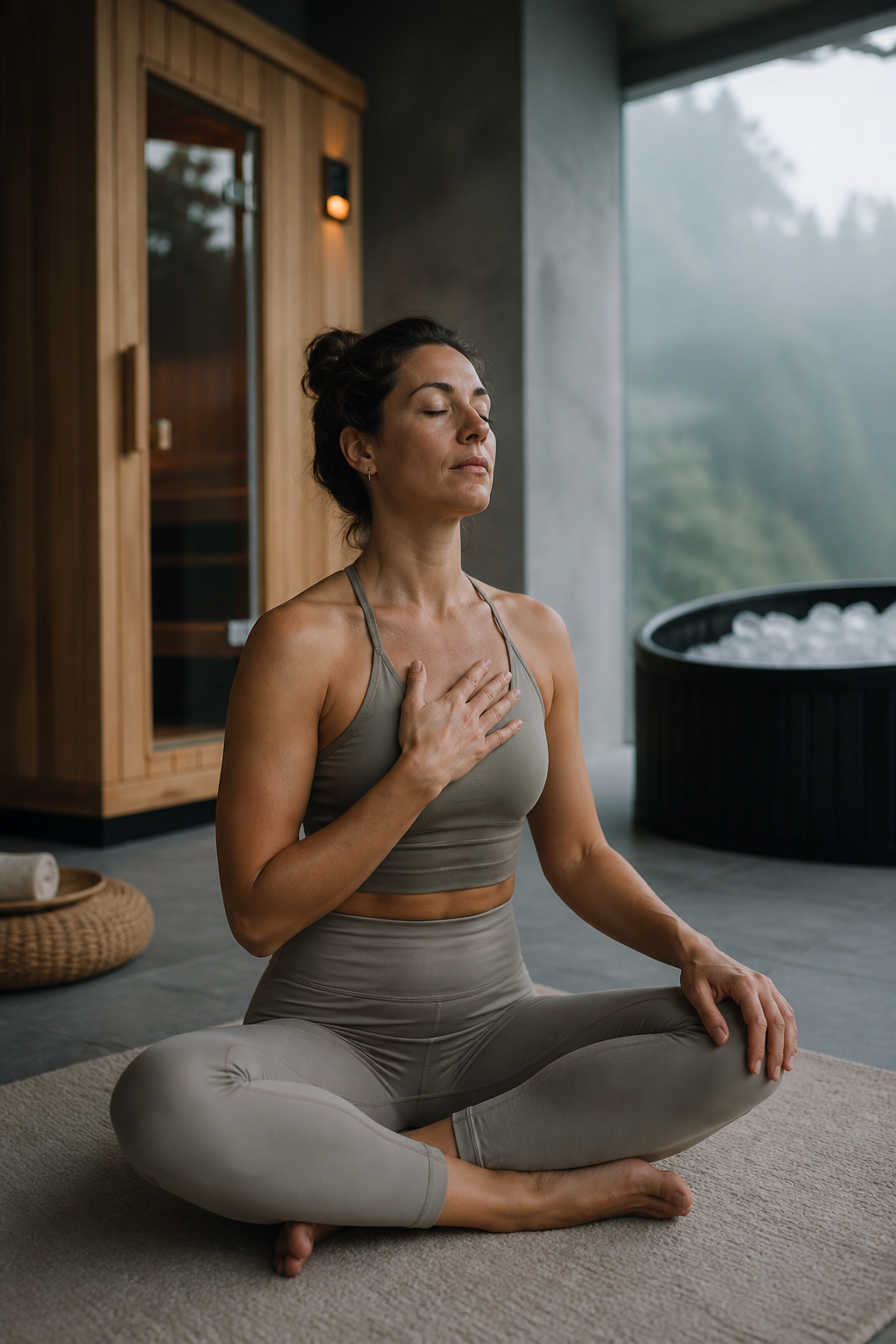
First seconds
A reflexive gasp, faster breath, higher pulse and pressure. This is often the most demanding moment — especially with heart or blood-pressure concerns.
Nawal Omar
We don’t enter the water to become someone else. We enter to stay with ourselves when the body says: this is new, this is strong — pay attention.
View the day retreat
With Nawal
Welcome. I’m Nawal — a nurse and yoga teacher. Today isn’t only about trying the cold or proving we are strong. It’s about understanding how the body works, hearing its limits, and staying present when fear rises — instead of fighting it or running from it.
This is not a competition, and there is no time you must reach. Success is not minutes in the water. Success is staying connected to your body — saying yes when yes is true, and stopping when your body needs to stop.
Before any practice, every participant is responsible for sharing health information. As a facilitator, I may pause the experience or ask for medical clearance when safety is unclear.
The path
A held arc: learn, enter, return. Always on land first. Always with choice.
We learn about breath and the nervous system, then practice short, safe rounds on land — never in water, never near water.
We prepare the body and learn how to enter cold water without racing and without pressure — head and neck stay above water.
We give time to warm, settle, and share — understanding what we learned about ourselves, not how long we stayed.
In the body
During faster breathing, carbon dioxide drops and blood chemistry shifts for a short time. That can bring lightness, tingling, or dizziness — not because the brain is “super-oxygenated,” but because vessels and nerves respond to that change.
During a short breath hold after the exhale, the urge to breathe returns gradually. We never chase the longest hold or the strongest dizziness. The aim is a brief, conscious pressure — then a full return to balance.
Less blood flow to the brain is not the goal. The real training is a small, regulatable stress — then bringing the whole body back to safety.
This is not medical treatment, and it does not replace therapy or a doctor’s care.
In the water
Cold shock is real. We meet it with longer exhales — never with breath holds in or near the water.
A reflexive gasp, faster breath, higher pulse and pressure. This is often the most demanding moment — especially with heart or blood-pressure concerns.
Breath may become more controllable. The body is still under stress. Numbness is not proof of “adaptation,” and we don’t extend time for bravado.
Core temperature can keep dropping for a while (afterdrop). We dry, warm gently, move lightly, and watch recovery — no sudden extremes.
Honest language
We may feel more alert energy, a stronger sense of agency, and a practical lesson in meeting pressure with breath. Research on inflammation and cold/breath protocols is promising but limited — small studies, mixed outcomes.
We do not claim the method cures depression, prevents disease, treats autoimmune conditions, or gives full control of the nervous system. Cold can raise blood pressure and heart rate before any calm arrives.
Today we didn’t learn how to defeat the cold. We learned how to stay with ourselves while something strong moves through us. Strength is not finishing at any cost — strength is knowing when to breathe, when to soften, and when to leave. Take that with you: the feeling is strong, but it doesn’t decide for you. You can feel, breathe, then choose.